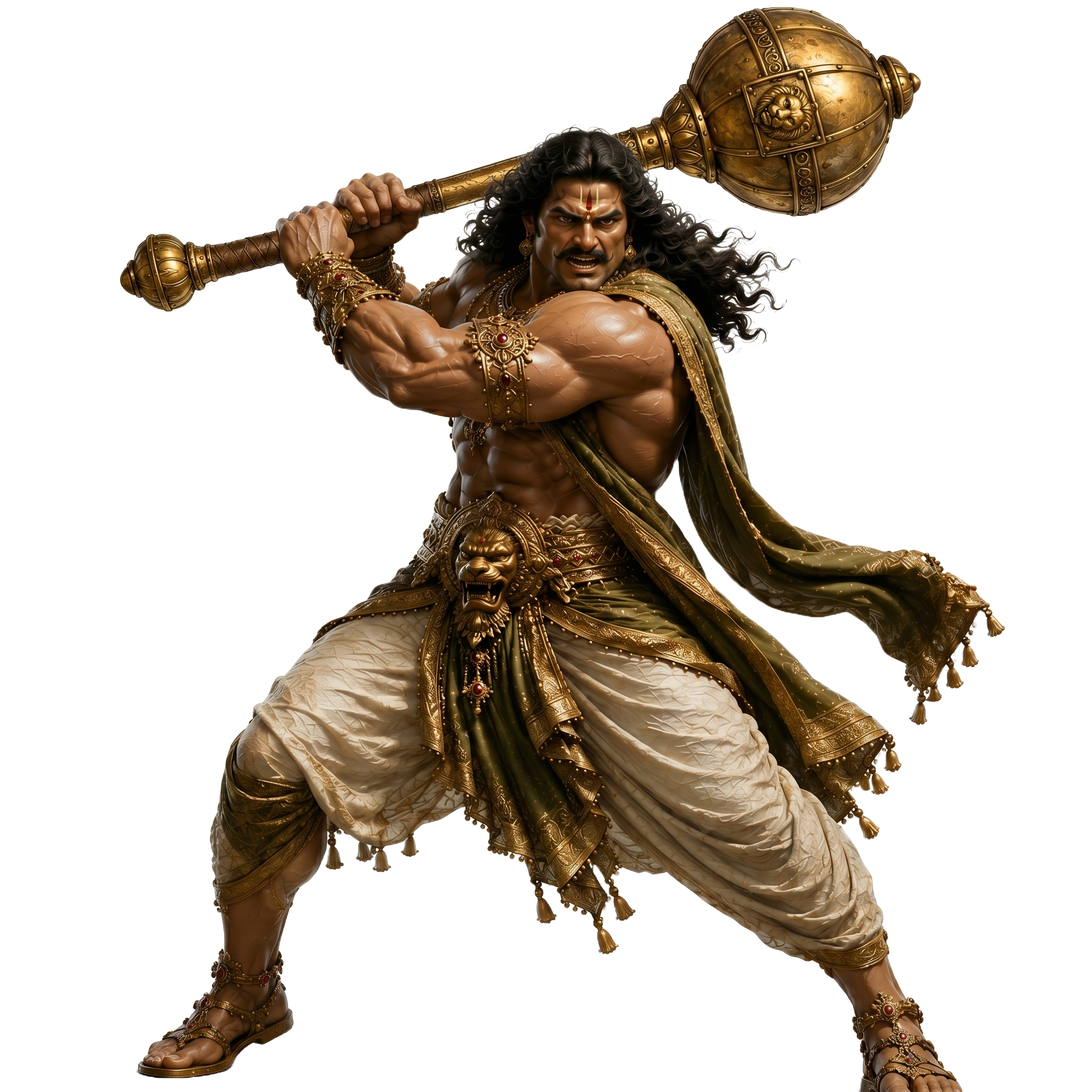
The Unbreakable Force
Bhima
Bhimasena · Vrikodara · Son of Vayu
The mightiest warrior among the Pandavas and the fearless son of Vayu, the Wind God. Blessed with immeasurable strength, Bhima shattered mountains, slew countless Rakshasas, and fulfilled every vow he made on the battlefield. Wielding his colossal mace with unmatched power, he became the unstoppable force of Dharma, ending the reign of Duryodhana and countless mighty warriors during the Kurukshetra War.
Biography
Origin
Personality
Stats
Details
- Specialty
- Titanic Strength
- Do You Know
- Bhima learned the art of mace combat from Balarama, making him one of the greatest mace warriors of his era. His duel with Duryodhana became one of the most famous battles in the Mahabharata.
Powers
Born after Kunti invoked Vayu, Bhima possesses extraordinary physical power from early life. His strength defines his wrestling, mace combat and repeated victories against opponents who overwhelm ordinary warriors.
Bhima survives extreme physical trials and sustains brutal close combat against formidable opponents. His fighting style depends on remaining dangerous even when a contest becomes prolonged and exhausting.
The gada is Bhima's signature battlefield weapon. His combination of strength and mace training makes him one of the epic's most dangerous close-range fighters.
Bhima defeats powerful non-human opponents including Hidimba and Baka through direct physical combat. These encounters establish his strength long before Kurukshetra.
Bhima is exceptionally dangerous when battle collapses into wrestling, grappling or mace range. His killing of Jarasandha demonstrates that his greatest advantage emerges when an opponent must meet his full physical force directly.
Abilities
Bhima is a master of mace combat and eventually faces Duryodhana in the duel that decides their lifelong rivalry. His technique is backed by extraordinary strength rather than finesse alone.
Bhima repeatedly defeats powerful enemies in close bodily combat. His confrontation with Jarasandha is the clearest demonstration of his ability to endure and finish a contest where weapons are not the deciding factor.
Bhima excels at breaking directly into enemy resistance and sustaining violent pressure. He is less defined by delicate manoeuvre than by the ability to make a position collapse once he reaches it.
During the Pandavas' incognito year, Bhima serves in Virata's court in a concealed identity associated with the royal kitchens. His time there shows that even the most physically recognisable Pandava could operate under restraint when survival demanded it.
Relationships
Bhima's defining rival from youth to the final hours of Kurukshetra. Duryodhana's early attempt to kill him becomes the beginning of a hatred that ends with their mace duel.
Bhima is one of Draupadi's five Pandava husbands. Her humiliation in the Kuru assembly ignites vows that Bhima carries through exile and fulfils with terrible force during the war.
Bhima's elder brother and king. Bhima remains fiercely loyal to him but often struggles with Yudhishthira's patience, restraint and willingness to endure injustice rather than answer it immediately with force.
Bhima and Arjuna form the Pandavas' most formidable combination of raw force and elite weapons mastery. Their strengths differ sharply, but both become essential to the Pandava survival and victory.
Krishna repeatedly gives direction to Bhima's immense power. Their cooperation is especially clear in the plan against Jarasandha and in the final struggle against Duryodhana.
Bhima's son by Hidimbi, born from the forest chapter of the Pandavas' exile. Ghatotkacha later fights for the Pandava side at Kurukshetra and becomes a major force in the night battle.
Timeline
- Early LifeBorn Through Kunti's Invocation of Vayu
Kunti invokes Vayu through her boon, and Bhima is born with the extraordinary strength that will define his life. His divine parentage is central to the epic's explanation of his physical power.
- YouthSurvives Duryodhana's Plot
Duryodhana plots against Bhima, poisoning him and having him cast into water. Bhima survives and returns, deepening the hostility that will follow both men toward Kurukshetra.
- Forest WanderingsSlayer of Hidimba and Baka
Bhima kills the rakshasa Hidimba and later destroys Baka, who had terrorised the people of Ekachakra. His Vayu-born strength becomes a shield for people who cannot resist such threats themselves.
- Rise of the PandavasThe Fall of Jarasandha
Bhima wrestles the powerful king Jarasandha in a punishing contest and kills him with Krishna's crucial guidance. Raw strength succeeds because strategy shows where to apply it.
- Kuru AssemblyVows Born from Draupadi's Humiliation
After Draupadi is humiliated in the assembly, Bhima makes terrible vows of vengeance against those responsible. Those promises survive exile and become personal objectives when war finally arrives.
- KurukshetraThe Gada Becomes Judgment
Bhima fights as one of the Pandavas' most destructive frontline warriors, using his gada and immense physical force against the Kaurava host. The weapon becomes inseparable from his identity as the brother who meets violence head-on.
- KurukshetraVengeance Against Dushasana
Bhima kills Dushasana and fulfils the terrible vow he made after Draupadi's humiliation. The episode is deliberately brutal in the epic, showing vengeance fulfilled without pretending that fulfilment is clean.
- End of KurukshetraThe Final Mace Duel
Bhima faces Duryodhana in single combat with the gada. He ultimately strikes Duryodhana on the thighs, contrary to conventional mace-fighting rules, fulfilling his vow and ending their lifelong rivalry at a morally contested cost.
Facts
Cards featuring Bhima
No cards featuring Bhima yet.
Stories about Bhima
No stories about Bhima yet.
Create a character card like Bhima
Turn your own characters into premium collectible cards manufactured by Cards Loomia.
Discussion
Loading comments…