CARDSLOOMIA
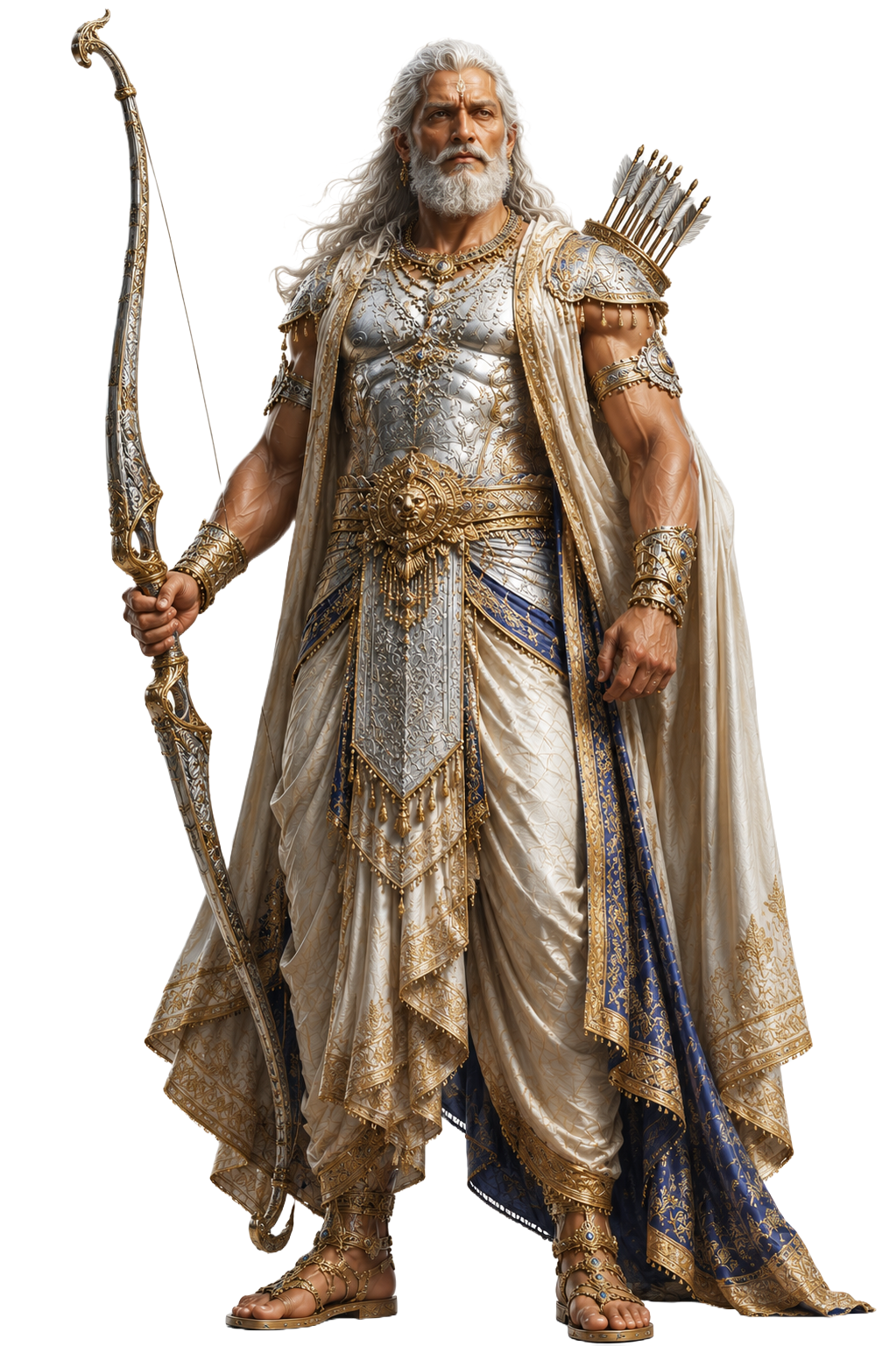
Bhishma – The Grand Patriarch

The Grand Patriarch

Bhishma – The Grand Patriarch

Bhishma · Devavrata · Gangeya · Guardian of the Kuru Throne

Mahabharata SagaFoil Card191.0

Bhishma gives up a crown, marriage and descendants so his father's chosen line can rule. Then he spends the rest of his life protecting that vow, even when loyalty to the Kuru throne places him on the battlefield against people he loves.

Biography

The primary source for this record is <b>Rung 1: Vyasa's Mahabharata, following the critical-text tradition</b>. Bhishma is born Devavrata, son of King Shantanu and the river goddess Ganga. The epic connects his birth with the Vasus and gives him an origin beyond ordinary royalty. Raised to become an extraordinary prince and warrior, he appears destined for the Kuru throne. Then his father's desire for Satyavati changes everything. Satyavati's father requires that her future sons inherit the kingdom. Devavrata renounces his claim to the throne. When that alone cannot remove concern that his own future children might contest the succession, he makes the vow that defines him: lifelong celibacy and renunciation of descendants. The vow is so terrible that he becomes known as Bhishma. Shantanu, overwhelmed by his sacrifice, grants him the power to choose the time of his death. From that moment, Bhishma's greatest power and greatest burden come from the same source: a promise he refuses to break. After Shantanu's death, Bhishma becomes the stabilising force behind the Kuru dynasty without taking the crown himself. He brings the princesses Amba, Ambika and Ambalika from Kashi for Vichitravirya. Amba reveals that her heart had already chosen King Salva, and Bhishma allows her to leave, but Salva rejects her after she has been carried away by another man. When Amba returns and demands that Bhishma marry her, his vow makes that impossible. Her life is shattered by a chain of decisions in which Bhishma's duty and her justice cannot be reconciled. She becomes his relentless enemy, and her story eventually returns to him through Shikhandin. Bhishma's martial authority is tested when Parashurama fights him over Amba's grievance. The confrontation between two immense warriors does not produce a simple defeat of Bhishma. He remains one of the rare figures capable of surviving such a contest. Yet his greatest conflicts are never merely about strength. In the Kuru court, he understands dharma deeply but is repeatedly trapped by competing obligations: loyalty to the throne, duty to the dynasty and the demands of justice. During Draupadi's crisis in the dice hall, even Bhishma acknowledges the difficulty of the legal question she raises. His knowledge does not always translate into the power to prevent wrongdoing. When Kurukshetra begins, Bhishma commands the Kaurava army despite his affection for the Pandavas. His loyalty is to the Kuru throne he has protected for most of his life. On the battlefield he is devastating, forcing the Pandavas to seek a way around the fact that defeating him through ordinary combat is nearly impossible. Bhishma himself reveals the condition that can be used against him: he will not fight Shikhandin as he would another warrior. Arjuna advances with Shikhandin before him and pierces Bhishma with arrows until the patriarch falls, his body held above the earth upon a bed of shafts. But Bhishma does not die. His boon allows him to wait. Lying on the arrow bed, he survives beyond the battle and later instructs Yudhishthira at immense length on kingship, duty, governance, conduct and liberation. Only when the proper solar period arrives does he release his life. Bhishma's dharma is therefore both magnificent and painful. Few characters sacrifice more for duty. Few demonstrate more clearly that a vow can preserve a kingdom for generations and still bind a righteous man inside consequences he can no longer control.

Origin

Bhishma is born as Devavrata to Shantanu and Ganga. The Mahabharata connects him with the Vasus, celestial beings whose earthly births follow a curse. Ganga bears their children and consigns the earlier newborns to the river according to the conditions behind that curse, while Devavrata survives when Shantanu finally intervenes. Ganga later returns the accomplished Devavrata to his father. He is recognised as a prince of extraordinary ability and established as Shantanu's heir. Nothing in his early position suggests that he lacks the right or capacity to rule. He loses the throne only because he voluntarily gives it away, then seals that sacrifice by renouncing marriage and children forever.

Personality

Bhishma is disciplined, formidable, self-controlled and almost impossibly loyal to vows once spoken. He can command armies and advise kings, yet he deliberately refuses kingship. He loves the Kuru family, including the Pandavas, but fights for the Kaurava throne because his concept of duty binds him to the dynasty's established authority. That is his central contradiction. Bhishma knows dharma at a depth few characters can match, but dharma in the Mahabharata is not always a clean road. His terrible vow gives him moral grandeur while also limiting his ability to correct the dynasty's later failures. He is strongest when sacrifice is required of himself and most tragic when protecting an old duty allows new injustice to grow.

Stats

Attack100
Defense100
Weapon Mastery100
Strength100
Strategy100
Divine Power99
Leadership100
Dharma100
Mobility98
Overall100

Details

Do You Know
Bhishma was born as Devavrata, one of the Eight Vasus cursed to be born on Earth. Unlike his brothers, who were released soon after birth, Devavrata remained on Earth to fulfill the Vasu's destiny and became the legendary Bhishma.

Powers

Choice of Death

Shantanu grants Bhishma the power to determine the time of his own death after the terrible vow that secures Satyavati's marriage and succession. This allows him to remain alive on the bed of arrows until he chooses the proper time to depart.

Supreme Martial Mastery

Bhishma is one of the epic's greatest warriors, formidable with the bow and capable of dominating large-scale battle. His command of weapons makes ordinary attempts to defeat him ineffective.

Celestial Heritage

The epic connects Bhishma with the Vasus and gives his birth a divine background through Ganga. His extraordinary nature is established before his human career as prince, guardian and warrior begins.

Unbreakable Vow

Bhishma renounces the throne, marriage and descendants so that Satyavati's line can inherit without challenge from him. His identity, authority and tragedy all grow from his refusal to violate that vow.

Arrow-Bed Endurance

After Arjuna's arrows bring him down with Shikhandin positioned before him, Bhishma remains alive upon the bed of shafts. His control over the timing of death turns battlefield defeat into a final period of teaching.

Mastery of Dharma and Kingship

After the war, Bhishma becomes Yudhishthira's teacher while lying on the arrow bed. His discourses cover royal duty, governance, ethics and liberation, revealing a mind as formidable as his martial skill.

Abilities

Master Archer

Bhishma's archery allows him to fight at the highest level of the epic's warfare and devastate opposing forces while commanding the Kaurava army.

Supreme Commander

As the first commander of the Kaurava forces at Kurukshetra, Bhishma combines battlefield authority, experience and strategic judgment on a massive scale.

Dynastic Statecraft

For generations Bhishma protects the continuity of the Kuru throne without claiming it himself. He acts as guardian, counsellor and stabilising authority through repeated succession crises.

Warrior Mobility

Bhishma operates as an aggressive chariot warrior rather than a static defender. His speed of engagement, archery and battlefield positioning make him difficult to contain through conventional combat.

Relationships

Shantanufamily

Bhishma's father and king of the Kurus. Bhishma's terrible vow is made to secure Shantanu's marriage to Satyavati, and Shantanu responds by granting him control over the time of his death.

Gangafamily

Bhishma's divine mother, who raises Devavrata away from Shantanu before returning the accomplished prince to his father.

Satyavatifamily

Bhishma sacrifices his throne, marriage and future descendants so Satyavati can marry Shantanu and her line can inherit the Kuru kingdom.

Ambarival

The Kashi princess whose life is transformed by Bhishma's actions and vow. Her unresolved grievance becomes a lifelong pursuit of his downfall and is ultimately connected to Shikhandin.

Parashuramarival

Parashurama confronts Bhishma on Amba's behalf. Their clash tests Bhishma against one of tradition's greatest warrior-sages without producing an ordinary decisive defeat.

Yudhishthiraother

Bhishma fights against Yudhishthira's side at Kurukshetra because of his obligation to the Kuru throne, yet after the war he becomes Yudhishthira's great teacher on kingship, duty and dharma.

Timeline

  1. Mahabharata Era
    Born as Devavrata

    Devavrata is born to King Shantanu and the goddess Ganga and is connected in the epic with the Vasus. He later returns to his father as an accomplished prince and heir.

  2. Youth
    The Terrible Vow

    To secure Shantanu's marriage to Satyavati, Devavrata renounces the throne and vows lifelong celibacy so no descendant of his can challenge Satyavati's line. The terrible vow earns him the name Bhishma.

  3. After the Vow
    Receives Choice of Death

    Moved by his son's sacrifice, Shantanu grants Bhishma the power to choose the time of his death. The boon later allows him to survive his fall at Kurukshetra until the moment he chooses to depart.

  4. Kuru Succession
    The Crisis of Amba

    Bhishma brings the Kashi princesses for Vichitravirya, but Amba's prior attachment to Salva creates a devastating conflict. Unable to marry her because of his vow, Bhishma becomes the focus of her demand for justice and vengeance.

  5. Before the Kuru War
    Faces Parashurama

    Parashurama confronts Bhishma over Amba's grievance. Their immense martial contest fails to produce a simple resolution, reinforcing Bhishma's status as one of the age's most formidable warriors.

  6. Kurukshetra
    Commands the Kaurava Army

    Bhishma becomes the first supreme commander of Duryodhana's forces. Though personally attached to the Pandavas, he fights for the Kuru throne and proves devastating in battle.

  7. Kurukshetra
    Falls Before Shikhandin and Arjuna

    Knowing Bhishma will not fight Shikhandin in the ordinary manner, the Pandavas place Shikhandin before Arjuna. Arjuna's arrows bring Bhishma down until his body rests upon a bed of shafts.

  8. After the Battle
    Chooses the Time of Death

    Bhishma remains alive on the arrow bed, instructs Yudhishthira on dharma and kingship, and waits for the desired solar period before relinquishing his life through the boon granted by Shantanu.

Facts

Primary Tradition
Rung 1 · Vyasa's Mahabharata · Critical-text tradition
Birth Name
Devavrata
Parents
King Shantanu and the goddess Ganga
Also Known As
Bhishma · Devavrata · Gangeya
Signature Weapon
Bow and arrows, used with supreme mastery throughout his career and as commander at Kurukshetra
Final Battlefield State
Bhishma falls beneath Arjuna's arrows with Shikhandin positioned before him, remains alive on a bed of arrows and later teaches Yudhishthira before choosing the time of his death.
Strengths
Supreme mastery of weapons and warfareAbsolute commitment to personal vowsExtraordinary strategic and political knowledgeCommand authority across generationsDivine heritage and control over the time of death
Weaknesses
Vows restrict his freedom to correct later crisesLoyalty to the throne can conflict with justiceRefuses full combat against ShikhandinDynastic duty binds him to the Kaurava war effortGreat knowledge does not always become decisive intervention
Weapons
Bow and Arrows

Cards featuring Bhishma – The Grand Patriarch

No cards featuring Bhishma – The Grand Patriarch yet.

Stories about Bhishma – The Grand Patriarch

No stories about Bhishma – The Grand Patriarch yet.

Create a character card like Bhishma – The Grand Patriarch

Turn your own characters into premium collectible cards manufactured by Cards Loomia.

Discussion

Comments are reviewed before appearing.

Loading comments…