CARDSLOOMIA
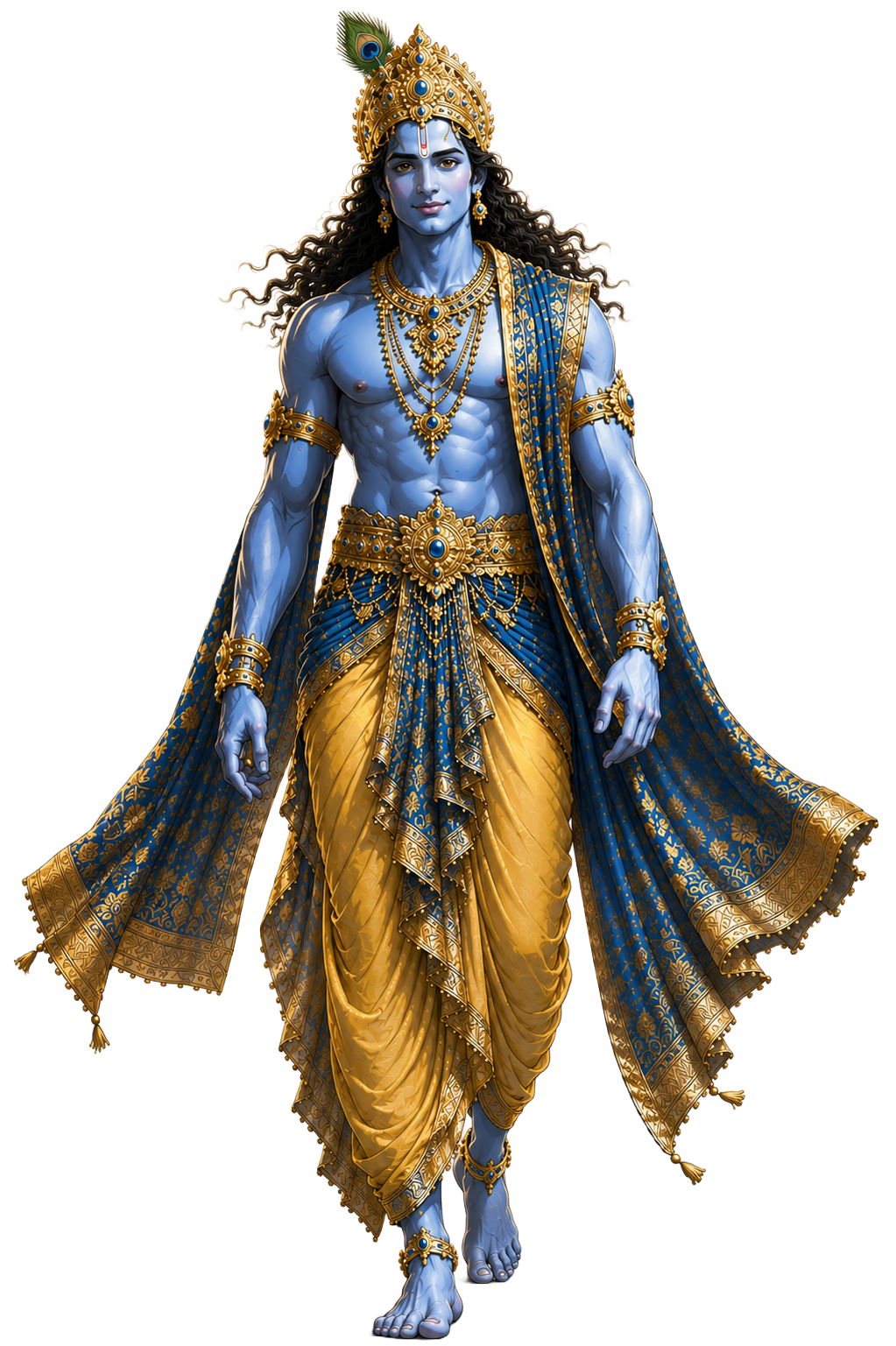
Krishna – Supreme Strategist

The Supreme Strategist

Krishna – Supreme Strategist

Vasudeva · Madhava · Keshava

Mahabharata SagaCharacter1.0

The Supreme Strategist of the Mahabharata and the divine incarnation of Lord Vishnu. Krishna guided the Pandavas through wisdom rather than weapons, delivering the eternal teachings of the Bhagavad Gita to Arjuna. Though he vowed not to wield a weapon in the Kurukshetra War, his unmatched intellect, divine power, and unwavering commitment to Dharma shaped the destiny of the world.

Biography

Krishna enters the Mahabharata not merely as a warrior or king, but as the figure who repeatedly sees where choices will lead before others do. He is Vasudeva Krishna of the Yadavas, son of Vasudeva and Devaki, kinsman of the Pandavas and especially close to Arjuna. The Mahabharata itself presents him in divine terms and identifies him with Narayana and the supreme divine reality. Later traditions, including the Bhagavata Purana and Vishnu Purana, narrate his birth, childhood and divine deeds in far greater detail; those belong to Rung 2 when used beyond what the Mahabharata itself establishes. Before Kurukshetra, Krishna repeatedly works to prevent catastrophe. He supports the Pandavas through crises, advises them in matters of statecraft and personally goes to the Kaurava court seeking a settlement before war. Peace fails. When both Arjuna and Duryodhana seek his support, Krishna offers a choice: his forces on one side, or Krishna himself on the other, unarmed and refusing to fight. Arjuna chooses Krishna. Duryodhana takes the forces. The choice captures the entire war before it begins: one man chooses military strength; the other chooses the mind that understands how strength must be used. Krishna becomes Arjuna's charioteer. On the field of Kurukshetra, Arjuna asks him to place the chariot between the armies. There Arjuna sees teachers, relatives and friends waiting to kill or be killed. Gandiva slips from purpose. Krishna answers him with the teaching preserved as the Bhagavad Gita: action, duty, knowledge, devotion, the nature of the self and freedom from attachment to the fruits of action. During this teaching Krishna reveals his universal form to Arjuna. The strategist is revealed as something far greater than a strategist. Once battle begins, Krishna does not fight as a conventional combatant, but his judgement repeatedly shapes the Pandava campaign. He guides Arjuna, reads opponents, understands vows and weaknesses, and supports decisions that expose how brutal the conflict between Dharma and survival has become. His role is not clean because the war itself is not clean. The epic repeatedly places him where rigid adherence to ordinary rules would allow destructive forces to prevail, making his strategy inseparable from the Mahabharata's hardest questions about Dharma. His vow of non-combat is tested most dramatically against Bhishma. When Arjuna fails to fight his grandsire with the force Krishna demands, Krishna leaps from the chariot in fury and rushes toward Bhishma with a chariot wheel in hand. Bhishma welcomes him. Arjuna restrains Krishna and promises to fight with full commitment. The moment matters because even the one guiding the war stands at the edge of breaking his own declared restraint. The Pandavas win, but Krishna's story does not end in triumph. The Yadava clan later destroys itself in internal violence, and Krishna eventually withdraws from the world after being struck by the hunter Jara. The Mahabharata ties his departure to the ending of an age. The strategist who could guide others through impossible choices does not preserve his own people from every consequence of time.

Origin

For Krishna's role in the Kurukshetra conflict, the primary source rung is Rung 1: Vyasa's Mahabharata, with the critical-text tradition preferred for the core record. He is Vasudeva Krishna, born to Vasudeva and Devaki and belonging to the Yadava lineage. The epic treats him not only as a human political and martial figure but as divine, identifying him with Narayana and revealing his supreme nature most directly in his teaching to Arjuna. Detailed accounts of Krishna's miraculous birth, his transfer from Mathura, childhood among the cowherds, the killing of Kamsa and many famous early exploits are developed especially in Rung 2 sources such as the Bhagavata Purana and Vishnu Purana. Those traditions are authoritative within their own textual settings, but their details should not be silently folded into the Mahabharata as though every version were identical.

Personality

Krishna is calm without being passive, compassionate without being naive and strategic without treating strategy as an end in itself. He can seek peace with patience, then become terrifyingly decisive once peace is exhausted. He understands people as sharply as he understands battle: pride, vows, grief, loyalty and hesitation all become forces he must navigate. His deepest contradiction is deliberate. He teaches action without attachment, yet intervenes constantly when Dharma is threatened. He refuses to wield weapons in the war, yet becomes the intelligence around which the Pandava victory turns. With Krishna, restraint is never the absence of power. It is power under command.

Stats

Attack100
Defense100
Weapon Mastery100
Strength95
Strategy100
Divine Power100
Leadership100
Dharma100
Mobility95
Overall100

Details

Specialty
Supreme Strategist
Do You Know
Krishna founded the fortified island city of Dwarka after relocating the Yadava kingdom from Mathura. This strategic move protected His people from repeated invasions by Jarasandha without engaging in a costly war.

Powers

Divine Nature

The Mahabharata presents Krishna as more than an extraordinary human ruler and strategist, identifying him with Narayana and the supreme divine reality. His authority therefore operates on both political and cosmic levels.

Vishvarupa

In the Bhagavad Gita, Krishna grants Arjuna the capacity to behold his universal form. Arjuna sees a reality containing countless beings and the terrible movement of cosmic destruction within the divine.

Divine Knowledge

Krishna teaches Arjuna about the self, action, duty, knowledge, devotion and liberation. His understanding reaches beyond battlefield tactics into the nature of existence itself.

Sudarshana Chakra

The Sudarshana Chakra is Krishna's celebrated divine discus across the broader Sanskrit tradition and is also associated with him in the Mahabharata. His Kurukshetra role is defined by his choice not to wield weapons as a combatant.

Extraordinary Divine Power

The epic repeatedly portrays Krishna as possessing power far beyond ordinary warriors, while emphasising that his decisive contribution at Kurukshetra comes through guidance, presence and strategy rather than conventional weapon use.

Abilities

Supreme Strategy

Krishna understands war as more than weapon against weapon. He reads motives, vows, alliances, timing and consequences, then turns that knowledge into decisions that repeatedly shape the Pandava campaign.

Diplomacy

Before the war, Krishna personally attempts to secure peace between the Pandavas and Kauravas. His willingness to negotiate before supporting battle makes war a final measure rather than his first answer.

Charioteering

Krishna serves as Arjuna's charioteer at Kurukshetra, placing himself at the centre of one of the war's most dangerous fighting positions while refusing the role of an armed combatant.

Leadership Through Counsel

Krishna rarely needs a throne or battlefield command to lead. His influence comes through judgement: knowing what must be said, when hesitation must end and when a warrior's strength alone is not enough.

Relationships

Arjunaally

Krishna's friend, kinsman and closest battlefield companion. As Arjuna's charioteer he guides both the horses and the warrior, and their dialogue at Arjuna's moment of collapse becomes the Bhagavad Gita.

Subhadrafamily

Krishna's sister and Arjuna's wife. Her marriage to Arjuna deepens the kinship between Krishna and the Pandava family, and their son is Abhimanyu.

Yudhishthiraally

Krishna supports Yudhishthira and the Pandava cause while repeatedly confronting the difficult distance between ideal Dharma and the choices required by political crisis and war.

Duryodhanarival

Krishna seeks peace before opposing Duryodhana's cause in the war. Duryodhana values the military forces available to him; Arjuna chooses the unarmed Krishna instead.

Bhishmaother

Krishna honours Bhishma's greatness yet opposes him at Kurukshetra. Their most charged encounter comes when Krishna rushes toward him with a chariot wheel and Bhishma receives the approach without fear.

Balaramafamily

Krishna's elder brother and a major Yadava figure. Their relationship belongs to the wider Yadava story, while their positions around the Kuru conflict are not identical.

Timeline

  1. Early Life
    Born into the Yadava Line

    Krishna is born to Vasudeva and Devaki and belongs to the Yadava lineage. Detailed narratives of his miraculous birth and childhood are especially developed in Rung 2 Puranic sources, including the Bhagavata Purana and Vishnu Purana.

  2. Before Kurukshetra
    The Peace Mission

    Krishna goes to the Kaurava court seeking a settlement before war consumes the Kuru family. Diplomacy fails, making clear that the coming conflict was not his first choice.

  3. Before the War
    Arjuna Chooses Krishna

    Krishna offers Arjuna and Duryodhana a choice between his military forces and Krishna himself, unarmed and not fighting. Arjuna chooses Krishna; Duryodhana accepts the forces.

  4. Kurukshetra
    The Bhagavad Gita

    When Arjuna loses the will to fight after seeing loved ones across the battlefield, Krishna answers his crisis with the teaching preserved as the Bhagavad Gita. The chariot becomes the setting for one of the tradition's central teachings on Dharma, action and liberation.

  5. Kurukshetra
    The Universal Form

    Krishna grants Arjuna divine sight and reveals his Vishvarupa, the universal form. The friend holding the reins is revealed as a cosmic reality beyond the battlefield.

  6. Kurukshetra
    The Chariot Wheel

    Enraged by Arjuna's insufficient resistance against Bhishma, Krishna rushes toward Bhishma with a chariot wheel despite his declared refusal to fight with weapons. Arjuna restrains him, and the moment exposes how fiercely Krishna is committed to the course he has chosen.

  7. Kurukshetra
    Victory Through Strategy

    Throughout the war Krishna's counsel helps the Pandavas confront warriors who cannot be overcome by straightforward force alone. His influence makes strategy, timing and knowledge as decisive as physical strength.

  8. After the War
    The End of the Yadavas

    Years after Kurukshetra, the Yadavas destroy one another in internal violence. Krishna later withdraws from the world after being struck by the hunter Jara, and his departure marks a profound transition in the epic's closing movement.

Facts

Also Known As
Vasudeva · Madhava · Keshava
Primary Tradition
Rung 1 — Vyasa's Mahabharata, with the critical-text tradition preferred for his Kurukshetra role; named Puranic traditions are treated separately as Rung 2
Parents
Vasudeva and Devaki
Divine Identity
The Mahabharata presents Krishna in divine terms and identifies him with Narayana and the supreme divine reality.
Role at Kurukshetra
Arjuna's unarmed charioteer, counsellor and strategist
Divine Weapon
Sudarshana Chakra, the divine discus strongly associated with Krishna across the Sanskrit tradition
Strengths
Unmatched strategic judgementUnwavering commitment to DharmaDivine knowledge and powerMastery of diplomacy and statecraftLeadership without dependence on weapons
Weaknesses
Bound by self-imposed promises and chosen rolesStrategy cannot prevent every tragic consequenceHis methods can challenge simple ideas of righteous conductEven divine guidance does not remove human free choiceCannot force others to accept peace or wisdom
Weapons
Sudarshana Chakra

Cards featuring Krishna – Supreme Strategist

No cards featuring Krishna – Supreme Strategist yet.

Stories about Krishna – Supreme Strategist

No stories about Krishna – Supreme Strategist yet.

Create a character card like Krishna – Supreme Strategist

Turn your own characters into premium collectible cards manufactured by Cards Loomia.

Discussion

Comments are reviewed before appearing.

Loading comments…