CARDSLOOMIA
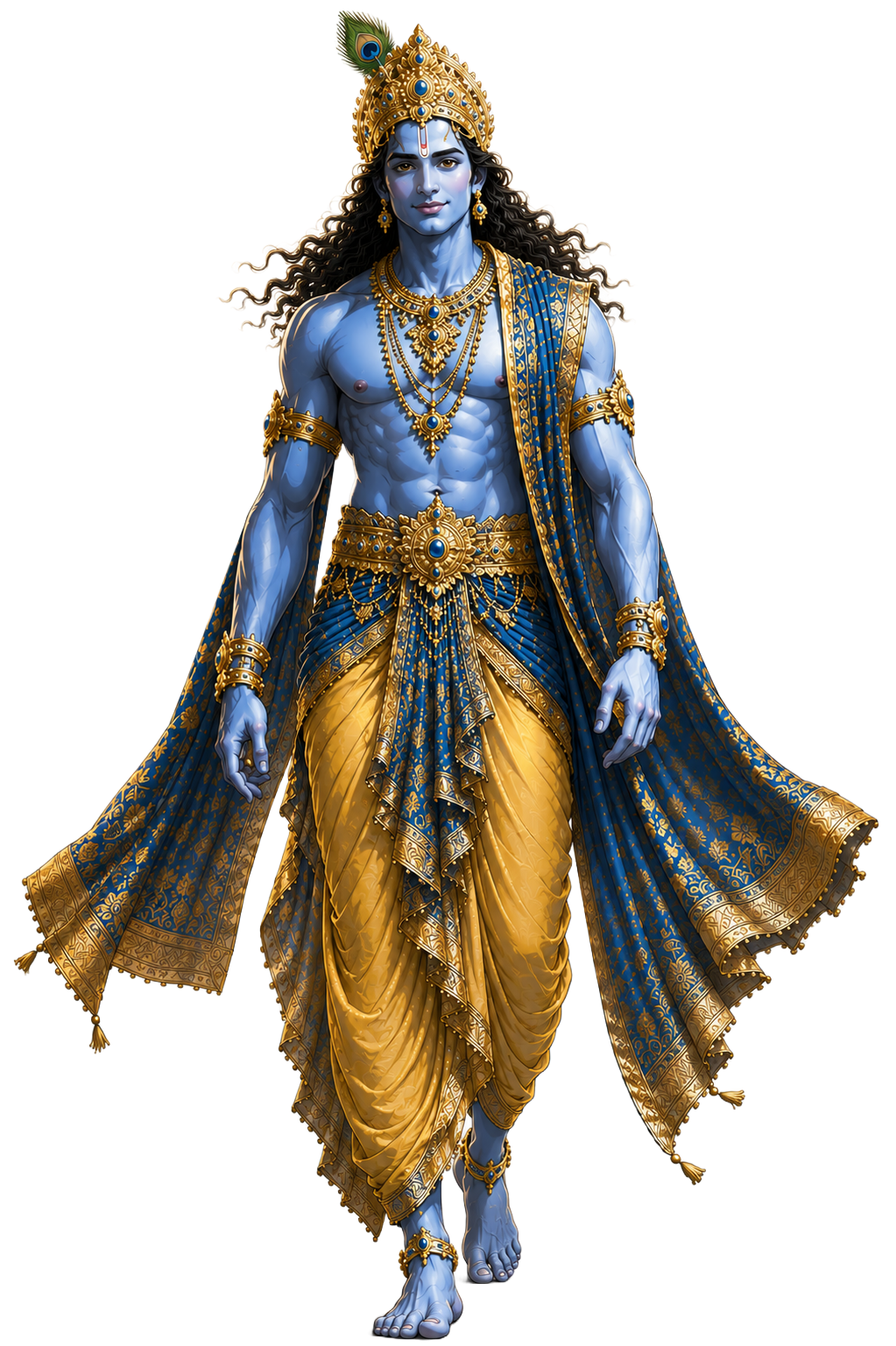
Krishna – Supreme Strategist

Supreme Strategist

Krishna – Supreme Strategist

Krishna · Vasudeva · Keshava · Madhava · Janardana

Mahabharata SagaFoil Card188.0

Krishna enters the Kuru crisis with the power to fight, then chooses a harder role: guide, envoy and charioteer. He offers peace before war, gives Arjuna the teaching of the Bhagavad Gita and shapes Kurukshetra through an unmatched understanding of people, timing, vows and dharma.

Biography

The primary source for this record is <b>Rung 1: Vyasa's Mahabharata, following the critical-text tradition</b>. Krishna, son of Vasudeva and Devaki and a leading figure among the Yadavas, enters the central Kuru story as kinsman and ally of the Pandavas. The Mahabharata presents him not merely as a prince or strategist but in explicitly divine terms, culminating most powerfully in his revelation to Arjuna. Yet his method throughout the political crisis is strikingly human in form: he speaks, negotiates, reads motives and acts at the exact point where ordinary rules can no longer contain the consequences of earlier choices. Before Kurukshetra, Krishna repeatedly works toward the Pandava cause without reducing every problem to direct force. In the campaign surrounding Yudhishthira's royal ambitions, he identifies Jarasandha as an obstacle that cannot be handled by a conventional frontal war alone. Krishna, Bhima and Arjuna approach the Magadha king, and Krishna's strategy leads to the decisive wrestling encounter in which Bhima kills Jarasandha. The pattern is established early: Krishna does not need to strike the final blow to determine where the blow must fall. When war between the Pandavas and Kauravas becomes imminent, both Arjuna and Duryodhana seek Krishna's support. Krishna offers a choice between himself, unarmed and refusing to fight, and his powerful Narayani force. Arjuna chooses Krishna. Duryodhana receives the troops. The decision captures Krishna's role in the war before it begins: armies matter, but judgment can matter more. Krishna later travels as a peace envoy to the Kuru court and argues for settlement. Peace fails because Duryodhana will not yield. Krishna therefore enters the war only after diplomacy has been exhausted. On the field of Kurukshetra, Krishna becomes Arjuna's charioteer. Before the first great clash, Arjuna sees teachers, relatives and friends across the battlefield and loses the will to fight. Krishna answers him with the teaching preserved as the Bhagavad Gita. He speaks of action without attachment, the enduring self, disciplined knowledge, devotion and duty. When Arjuna asks to behold his supreme form, Krishna grants divine sight and reveals the overwhelming universal form. The warrior who had been staring at relatives now sees existence, destruction and cosmic order on a scale beyond ordinary human vision. Krishna's strategy remains decisive once battle begins. He understands that several Kaurava champions cannot be defeated by straightforward strength alone. Against Bhishma, he supports the use of Shikhandin's presence to create the opening through which Arjuna can bring the patriarch down. When Jayadratha must be reached after Abhimanyu's death, Krishna drives and guides Arjuna through a battlefield built to delay him. Against Drona, Karna and finally Duryodhana, Krishna repeatedly recognises the vulnerabilities created by vows, curses, prior acts and battlefield conditions. These choices are morally severe. The epic does not make Kurukshetra clean simply because Krishna guides the victorious side. Krishna's role also exposes the cost of strategy. He cannot preserve everyone. Abhimanyu dies. Draupadi's sons die. The Yadavas themselves later destroy one another in the catastrophe at the end of Krishna's earthly life. After that destruction, Krishna withdraws into the forest and is struck by the hunter Jara, who mistakes part of his body for an animal target. Krishna's departure marks the closing movement of the epic age. His greatness is not that he prevents every tragedy. It is that he sees farther than the people around him, acts within a world already damaged by human choices and keeps directing action toward dharma even when every available path carries a cost.

Origin

In the Mahabharata's genealogical world, Krishna is born to Vasudeva and Devaki of the Yadava line and is closely connected with Balarama and the Vrishni-Andhaka clans. The epic knows and repeatedly affirms his extraordinary divine identity, while many detailed childhood narratives familiar across India are developed much more fully in later texts such as the Harivamsha and Bhagavata Purana and are therefore not merged here into the Rung 1 Mahabharata account. Within the Mahabharata itself, Krishna's divinity becomes impossible to reduce to political reputation alone. He is identified with the supreme divine reality in major theological passages, and the Bhagavad Gita places that identity at the centre of Arjuna's revelation. The strategist holding the reins of a chariot is simultaneously the being who reveals the cosmic form.

Personality

Krishna is calm under pressure, politically exact, compassionate without being naive and willing to use difficult means when conventional righteousness has already been weaponised by people acting in bad faith. He offers peace before war and counsel before force, but once war becomes unavoidable he does not pretend that victory against Bhishma, Drona, Karna and Duryodhana can be achieved by strength alone. He reads vows, pride, fear, timing and consequence. His deepest contrast is visible at Kurukshetra: the figure with the widest power chooses not to wield a battlefield weapon as his primary role, but to hold Arjuna's reins, speak when Arjuna collapses and direct another warrior toward action. Strategy, for Krishna, is never merely winning. It is knowing what must be done when every easy choice has already disappeared.

Details

Do You Know
Krishna founded the fortified island city of Dwarka after relocating the Yadava kingdom from Mathura. This strategic move protected His people from repeated invasions by Jarasandha without engaging in a costly war.

Powers

Vishvarupa

At Arjuna's request in the Bhagavad Gita, Krishna grants him divine sight and reveals the universal form. Arjuna beholds an overwhelming vision in which divine majesty, creation and destruction exceed ordinary human perception.

Sudarshana Chakra

The Sudarshana Chakra is Krishna's divine discus and appears as his weapon in the Mahabharata tradition, including his killing of Shishupala. At Kurukshetra, however, Krishna's chosen role is that of an unarmed charioteer rather than a conventional combatant.

Divine Knowledge

Krishna's teaching to Arjuna addresses the self, action, duty, knowledge, devotion and liberation. His insight operates beyond battlefield tactics and frames the war inside a larger understanding of existence and dharma.

Strategic Foresight

Krishna repeatedly identifies the hidden condition on which an apparently impossible victory depends. His influence is decisive against enemies whose strength cannot be overcome through straightforward combat alone.

Divine Manifestation

The Mahabharata presents Krishna's human political presence alongside explicit manifestations of divine identity. His revelation of transcendent form makes clear that the charioteer beside Arjuna cannot be understood as an ordinary king alone.

Dharma Guidance

Krishna does not remove Arjuna's freedom of choice; he teaches, reveals and directs until Arjuna can act with understanding. His power as guide lies in turning moral paralysis into deliberate responsibility.

Abilities

Supreme Strategy

Krishna reads the battlefield as a network of vows, weaknesses, loyalties and consequences rather than a simple contest of force. He repeatedly creates the conditions in which stronger or seemingly invulnerable opponents can be defeated.

Diplomacy

Before Kurukshetra, Krishna goes to the Kuru court as a peace envoy and argues for settlement. His willingness to negotiate before supporting war is essential to understanding his role in the conflict.

Chariot Command

As Arjuna's charioteer, Krishna controls movement, positioning and timing while simultaneously advising the warrior carrying Gandiva. Their partnership turns mobility and judgment into a single battlefield system.

Reading of Human Motive

Krishna understands how pride, gratitude, vows, grief and ambition shape decisions. His conversations with figures such as Arjuna and Karna show strategy operating through knowledge of people as much as knowledge of war.

Relationships

Arjunaally

Krishna's kinsman, friend and chosen warrior at Kurukshetra. Krishna becomes his charioteer, teaches him the Bhagavad Gita and guides him through the war's most difficult strategic and moral decisions.

Balaramafamily

Krishna's elder brother and a major Yadava figure. Their relationships with the Kuru warriors do not always produce identical political choices, especially around the final conflict.

Subhadrafamily

Krishna's sister and Arjuna's wife. Her marriage strengthens the kinship between Krishna's Yadava family and the Pandavas, and she becomes the mother of Abhimanyu.

Yudhishthiraally

Krishna supports Yudhishthira's cause, advises the Pandavas through political crises and later helps guide the transition from devastating war toward restored kingship.

Karnaother

Before Kurukshetra, Krishna reveals Karna's true birth and offers him a place with the Pandavas. Karna refuses to abandon Duryodhana, and Krishna recognises that loyalty as one of the forces locking the war into place.

Duryodhanarival

Duryodhana's refusal to yield a just settlement defeats Krishna's peace mission. At Kurukshetra, Krishna becomes the strategic mind guiding the side opposed to his rule.

Timeline

  1. Mahabharata Era
    Prince and Leader Among the Yadavas

    Krishna emerges as a central Yadava figure, son of Vasudeva and Devaki and kinsman of the Pandavas. His political influence and divine identity become increasingly central to the epic's unfolding crisis.

  2. Before the Rajasuya
    Strategy Against Jarasandha

    Krishna identifies Jarasandha as a major obstacle and accompanies Bhima and Arjuna to confront him. The mission ends with Bhima defeating Jarasandha in direct combat, clearing a crucial political barrier.

  3. Rajasuya
    Sudarshana Ends Shishupala's Defiance

    At Yudhishthira's royal sacrifice, Shishupala repeatedly abuses Krishna and challenges the honour shown to him. Krishna ultimately kills Shishupala with the Sudarshana Chakra.

  4. Before Kurukshetra
    Arjuna Chooses Krishna

    Krishna offers a choice between himself, unarmed and not fighting, and his Narayani force. Arjuna chooses Krishna, while Duryodhana takes the military force.

  5. Peace Mission
    Makes the Final Case for Settlement

    Krishna travels to the Kuru court as an envoy and seeks a peaceful resolution before war. Duryodhana refuses a settlement, and diplomacy gives way to Kurukshetra.

  6. Kurukshetra
    Reveals the Vishvarupa

    When Arjuna collapses before the battle, Krishna teaches him the path preserved as the Bhagavad Gita. At Arjuna's request, he grants divine sight and reveals the overwhelming universal form.

  7. Kurukshetra
    Guides the Pandavas Through Impossible Battles

    Krishna's counsel shapes the strategies used against Bhishma and other formidable Kaurava champions and guides Arjuna through decisive confrontations. He fights the war primarily through insight, timing and chariot command rather than conventional weapon use.

  8. End of the Yadava Age
    Departure After the Yadava Destruction

    After the Yadavas destroy one another in the final catastrophe of their clan, Krishna withdraws to the forest. The hunter Jara strikes him by mistake, and Krishna's departure marks the closing of an age.

Facts

Primary Tradition
Rung 1 · Vyasa's Mahabharata · Critical-text tradition
Parents
Vasudeva and Devaki
Also Known As
Vasudeva · Keshava · Madhava · Janardana
Defining Battlefield Role
Arjuna's charioteer and counsellor at Kurukshetra, having chosen not to fight as a conventional armed warrior in the war
Divine Weapon
Sudarshana Chakra, the discus associated with Krishna and used by him against Shishupala in the Mahabharata narrative
Source Boundary
Many famous details of Krishna's childhood are narrated much more fully in later traditions such as the Harivamsha and Bhagavata Purana; they are not merged into this Rung 1 Mahabharata record as though all sources were identical.
Strengths
Unmatched strategic foresightDivine knowledge joined with practical judgmentMastery of diplomacy and psychological insightAbsolute composure in battlefield crisisAbility to align action with larger questions of dharma
Weaknesses
Cannot force others to choose peace or righteousnessStrategy often operates inside morally severe circumstancesBound by the consequences of choices made by allies and enemiesDoes not prevent every loss suffered by those he guidesHis own Yadava clan ultimately falls to internal destruction
Weapons
Sudarshana Chakra

Cards featuring Krishna – Supreme Strategist

No cards featuring Krishna – Supreme Strategist yet.

Stories about Krishna – Supreme Strategist

No stories about Krishna – Supreme Strategist yet.

Create a character card like Krishna – Supreme Strategist

Turn your own characters into premium collectible cards manufactured by Cards Loomia.

Discussion

Comments are reviewed before appearing.

Loading comments…