CARDSLOOMIA
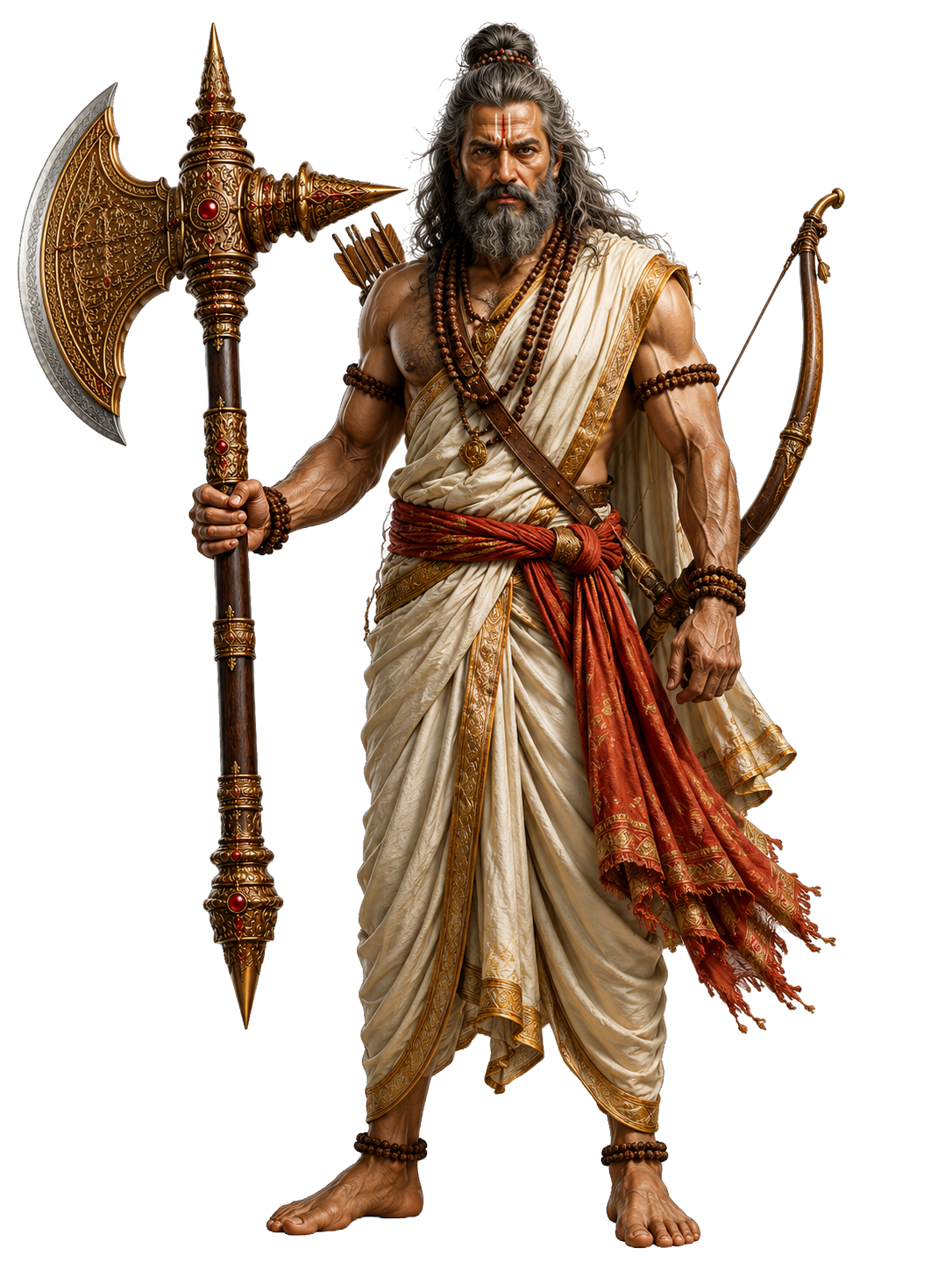
Parshurama

The Axe-Bearing Brahmin

Parshurama

Bhargava Rama · Jamadagnya · The Sixth Avatar of Vishnu

Ramayana Saga

Parashurama is the warrior-sage who broke the pride of tyrannical kings before the Ramayana began. When Rama strings the Vaishnava Bow, Parashurama recognizes that a new age has arrived and quietly steps aside.

Biography

Parashurama, the son of the sage Jamadagni and Renuka, stands at the meeting point of ascetic discipline and unmatched martial power. Though born a brahmin, he is renowned as the greatest wielder of the axe granted by Shiva. His story before the Ramayana is remembered through the Mahabharata and later Puranic traditions, where he wages war against oppressive kshatriya rulers after the murder of his father. These events establish him as a fearsome defender of justice, but they occur before the narrative of the Valmiki Ramayana. When Parashurama enters the Ramayana, his era is already drawing to a close. News reaches him that the mighty bow of Shiva has been broken during Sita's svayamvara. He appears before the wedding procession in blazing anger, believing that only an extraordinary warrior could have performed such a feat. Carrying the Vaishnava Bow, he challenges Rama to prove his worth. Rama accepts the bow with calm confidence. He strings it effortlessly and prepares to release an arrow. At that moment Parashurama understands that the prince before him is no ordinary human. The encounter is not a duel of destruction but a transfer of destiny. Realizing that Vishnu's mission now rests with Rama, Parashurama yields, acknowledges Rama's greatness, and withdraws from worldly affairs. The Ramayana presents Parashurama as powerful but not invincible. His fury is real, yet it gives way to discernment when confronted with truth. He does not cling to pride once he recognizes the will of dharma. His departure marks the passing of one divine age into another, from the warrior who punished unrighteous rulers to the king who would embody righteous rule.

Origin

The Valmiki Ramayana introduces Parashurama as the celebrated Bhargava sage already known throughout the world. It does not narrate his early life in detail. The Mahabharata and later Puranas identify him as the son of Jamadagni and Renuka, born into the lineage of the sage Bhrigu. Shiva grants him the divine axe known as the Parashu, and after Jamadagni is slain by kshatriya rulers, Parashurama destroys oppressive kshatriyas repeatedly before eventually renouncing conquest and devoting himself to austerity.

Personality

Parashurama is intense, disciplined, and uncompromising. He responds fiercely to injustice and insults against dharma, yet he is not blinded forever by anger. When he recognizes genuine righteousness, he accepts it without hesitation, even when it requires surrendering his own place in history. His strength lies not only in battle but in knowing when the time to fight has ended.

Powers

Parashu

The divine axe granted by Shiva, the weapon that defines Parashurama's identity and his campaigns against unrighteous rulers.

Master of the Vaishnava Bow

Possesses and presents the Vaishnava Bow during his encounter with Rama, using it to test the prince's true nature.

Divine Martial Prowess

Combines brahminical austerity with extraordinary mastery of celestial warfare.

Tapas

His severe ascetic discipline grants immense spiritual power and unwavering resolve.

Avatar of Vishnu

Recognized in later tradition as the sixth avatar of Vishnu, whose mission precedes that of Rama.

Abilities

Supreme Weapon Mastery

Excels in the use of divine weapons through rigorous discipline and instruction from Shiva.

Ascetic Discipline

Draws strength from lifelong austerity, self-control, and devotion.

Discernment

Recognizes Rama's divine greatness and willingly yields once the truth becomes clear.

Relationships

Jamadagnifamily

His father, whose death becomes the turning point of Parashurama's early life.

Renukafamily

His mother and a revered figure in his lineage.

Shivamentor

Grants Parashurama the divine Parashu and is revered as his martial teacher.

Ramaother

Tests Rama with the Vaishnava Bow before acknowledging his divine mission.

Sitaother

Her svayamvara leads directly to Parashurama's encounter with Rama through the breaking of Shiva's bow.

Timeline

  1. Before the Ramayana
    Birth in the Bhargava Lineage

    Born to Jamadagni and Renuka as the sage-warrior later known as Parashurama.

  2. Before the Ramayana
    Receives the Parashu

    Obtains the divine axe from Shiva, the weapon that becomes his enduring symbol.

  3. Before the Ramayana
    Campaign Against Oppressive Kshatriyas

    Avenges the death of Jamadagni by defeating tyrannical kshatriya rulers, as told in the Mahabharata and later Puranas.

  4. Ramayana
    Hears of Shiva's Bow

    Learns that the great bow has been broken during Sita's svayamvara and confronts Rama.

  5. Ramayana
    The Test of the Vaishnava Bow

    Challenges Rama with the Vaishnava Bow, only to witness the prince string it with effortless mastery.

  6. Ramayana
    Acknowledges Rama

    Accepts Rama's supremacy, yields his challenge, and departs to continue his ascetic life.

Facts

Primary Ramayana Source
Valmiki Ramayana.
Earlier Deeds
His campaigns against oppressive kshatriyas are primarily described in the Mahabharata and later Puranas.
Also Known As
Bhargava Rama and Jamadagnya.
Signature Weapon
The Parashu, the divine axe granted by Shiva.
Divine Bow
Carries the Vaishnava Bow during his encounter with Rama.
Strengths
Unmatched mastery of the axeImmense ascetic powerFearless before kingsUnwavering devotion to dutyAccepts truth over pride
Weaknesses
Quick to angerUncompromising judgmentBurdened by memories of vengeanceWithdraws from worldly rule
Weapons
ParashuVaishnava Bow

Cards featuring Parshurama

No cards featuring Parshurama yet.

Stories about Parshurama

No stories about Parshurama yet.

Create a character card like Parshurama

Turn your own characters into premium collectible cards manufactured by Cards Loomia.

Discussion

Comments are reviewed before appearing.

Loading comments…